The Constitution of India, in Part III (Articles 12-35), guarantees six fundamental rights primarily to citizens, ensuring their dignity, liberty, and equality. These rights—Equality, Freedom, against Exploitation, Freedom of Religion, Cultural and Educational Rights, and Constitutional Remedies—form the bedrock of Indian democracy.
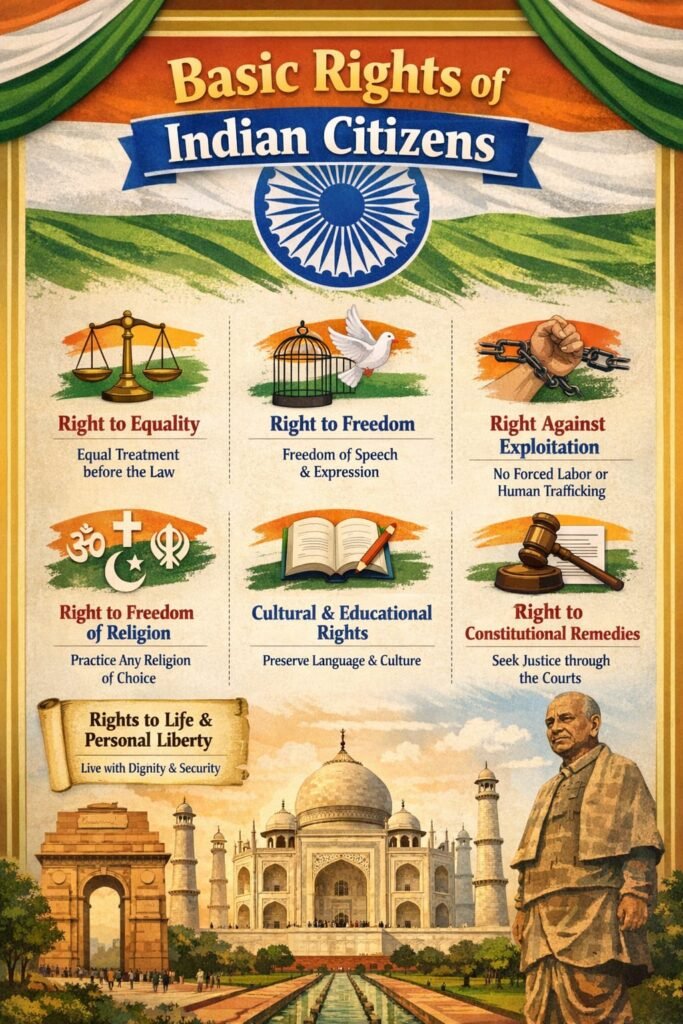
Right to Equality
The Right to Equality (Articles 14-18) ensures no citizen faces discrimination based on religion, race, caste, sex, or birthplace. Article 14 mandates equality before the law and equal legal protection for all within India, preventing arbitrary state action. Article 15 prohibits state discrimination in access to public places or services on prohibited grounds, while allowing affirmative action for disadvantaged groups like Scheduled Castes and Tribes. Article 16 guarantees equal opportunity in public employment, barring discrimination in state jobs.
Article 17 abolishes untouchability, criminalizing its practice in any form to eradicate social stigma historically tied to caste. Article 18 abolishes titles except military or academic honors, promoting social equality by ending hereditary privileges like “Raja” or “Rai Bahadur.” Courts have expansively interpreted these provisions; for instance, in Maneka Gandhi v. Union of India (1978), equality evolved to include reasonableness and non-arbitrariness. This right applies only to citizens, fostering a society where merit and ability prevail over birth-based hierarchies.
These provisions have transformed India from a rigid caste society to one emphasizing meritocracy. Landmark cases like Indra Sawhney v. Union of India (1992) upheld reservations up to 50% while balancing equality. Violations can be challenged via writs under Article 32. Overall, this right upholds the rule of law, with over 100 Supreme Court judgments reinforcing its scope against executive overreach.
Right to Freedom
Articles 19-22 outline the Right to Freedom, with Article 19 exclusively for citizens granting six freedoms: speech and expression, peaceful assembly without arms, forming associations/unions, free movement across India, residence/settlement anywhere, and practicing any profession, trade, or business. These are not absolute; reasonable restrictions apply for state security, public order, decency, or morality.
Article 20 protects against ex-post facto laws (no retroactive criminalization), double jeopardy (no repeat trial for the same offense), and self-incrimination (no forced testimony). Available to all persons, it safeguards judicial fairness. Article 21, pivotal for all persons, declares no deprivation of life or personal liberty except by “procedure established by law,” expanded judicially to include “due process” via Maneka Gandhi (1978), encompassing privacy, health, education, and clean environment.
Article 22 prevents arbitrary arrests/detentions, mandating grounds of arrest disclosure, lawyer access within 24 hours, and magistrate production within 24 hours. Preventive detention laws like NSA have restrictions (max 3 months without advisory board review). This right empowers citizens against state excesses; e.g., Shreya Singhal v. Union of India (2015) struck down Section 66A of the IT Act for chilling free speech.
Freedoms under Article 19 promote democracy—speech enables dissent, assembly fuels protests like farmers’ agitations. Judicial activism has broadened Article 21 to rights like speedy trials (Hussainara Khatoon, 1979) and LGBTQ+ decriminalization (Navtej Singh Johar, 2018).
Right against Exploitation
Articles 23-24 prohibit exploitation, banning human trafficking, forced labor (begar), and child labor under 14 in hazardous jobs. Article 23 voids traffic in humans and begar, punishable as offenses; courts interpret “forced labor” broadly, including state-compelled work without pay, as in People’s Union for Democratic Rights v. Union of India (1982).
Article 24 forbids employment of children below 14 in factories, mines, or hazardous work, enforced via laws like Child Labour Act, 1986. This right targets historical practices like bonded labor, affecting millions. Remedies include Supreme Court directives for rehabilitation funds from violators.
Post-independence, bonded labor persists in rural areas, but interventions like the Bonded Labour System (Abolition) Act, 1976, aid eradication. Supreme Court in Bandhua Mukti Morcha v. Union of India (1984) ordered surveys and rehabilitation. Available to all, it upholds human dignity against economic coercion.
Right to Freedom of Religion
Articles 25-28 ensure secularism. Article 25 grants freedom of conscience, practice, profess, and propagate religion, subject to public order, morality, health. Article 26 allows religious denominations to manage affairs, own property. Article 27 bars taxes for specific religions; Article 28 prohibits religious instruction in state-funded schools.
Citizens enjoy this fully; e.g., Sabarimala (2018) struck temple entry bans for women. State regulates secular aspects like temple administration (Shirur Mutt, 1954).
Cultural and Educational Rights
Articles 29-30 protect minorities. Article 29 preserves language, script, culture; Article 30 allows minorities to establish/administer educational institutions. State cannot discriminate in aid based on minority status (St. Stephen’s College v. University of Delhi, 1992).
Right to Constitutional Remedies
Article 32 empowers direct Supreme Court access for enforcement via writs (habeas corpus, mandamus, etc.), called “heart and soul” by Dr. Ambedkar.